
Read this guide in
Monk fruit extract specifications
Mogroside V Grades & COA: Buy the Grade, Then Check the Batch
Start with the Mogroside V specification when buying monk fruit extract, then verify the lot on its certificate of analysis (COA). To compare suppliers, check what was measured, how it was measured and the basis for reporting the result.

What do V25% and V50% mean?
Mogroside V is one of the compounds that give monk fruit extract its sweet taste. V25% and V50% are grades that specify the Mogroside V content of the extract.
| Grade | What the nominal content means |
|---|---|
| V25% | 25 g of Mogroside V per 100 g of extract on the stated reporting basis. |
| V50% | 50 g of Mogroside V per 100 g of extract on the same reporting basis. |
These percentages describe Mogroside V content. Total mogrosides, the extraction ratio and sweetness relative to sugar are separate measures. Check the specification for the content requirement and reporting basis, such as dry basis or as supplied. Then use the batch COA to check the measured result. V25% and V50% are our two standard grades. Other content specifications, including V40% and V70%, can be made to order. Tell us your target content, application and estimated quantity so we can confirm the specification and supply arrangements. Ask separately about availability of organic V50%.
How is monk fruit extract made?
Hot water draws soluble components out of crushed monk fruit. Clarification and filtration remove pulp and other insoluble material. Separation and purification can then increase the proportion of Mogroside V in the extract. One published process uses resin adsorption and elution, followed by concentration and drying. The exact steps depend on the process and the target grade.
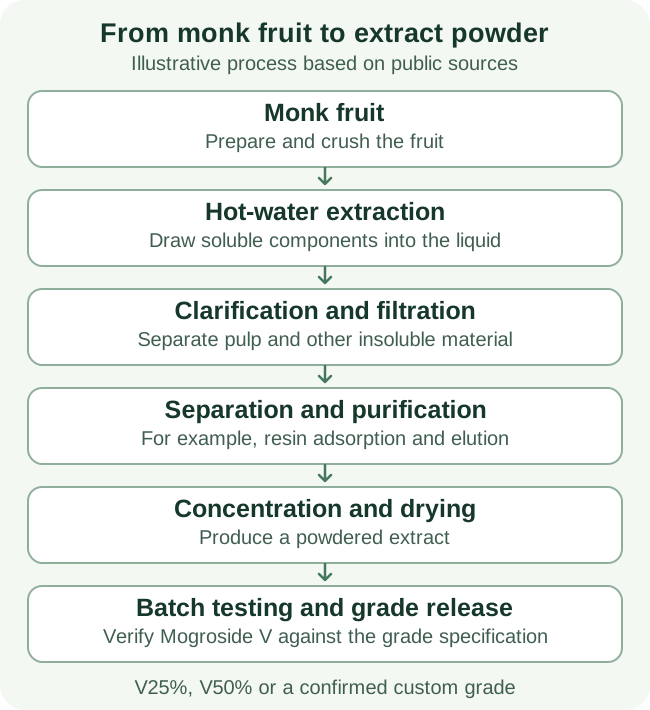
The process describes how the extract is made. The specification sets the requirements, and the batch COA records what the lot measured.
Three checks for comparing quotes
| What to check | What it settles | What it does not settle |
|---|---|---|
| Analyte: Mogroside V, or total mogrosides? | Which measure you are comparing | A total-mogrosides percentage is not a Mogroside V percentage, and vice versa |
| Method and basis: HPLC or UV? Dry basis or as supplied? | Whether two numbers are comparable at all | Two percentages on different bases are not two grades |
| Batch result: the COA for your lot | What you are actually buying | A specification sheet states a requirement; it is not a result |
Terms such as “pure,” an extract ratio such as 10:1, and a laboratory reference standard describe different things. Ask for the Mogroside V specification and the result for the lot you are buying. An extract ratio of 10:1 gives no Mogroside V percentage. Order a food ingredient for formulation, even if a laboratory standard is listed for food analysis. A specification of ≥50% sets the requirement. A COA result of 50.17% reports what a particular lot measured. Keep the sample code with its COA. If the shipment comes from another lot, check that lot’s own COA.
V25% or V50%? Choose by taste and application
Our V25% sweetens the product and adds a recognizable monk fruit note. It is worth trying in tea, dairy products, flavored drinks and strong-flavored products such as cocoa or strong coffee when that note fits the recipe. V25% is also our benchmark for evaluating taste consistency. Our V50% gives a cleaner sweetness and has a less pronounced monk fruit note. Start with V50% when you want the sweetness to come through more clearly and the product already has the main flavor you want to keep. It is also a starting point when you want to use less extract. Bring the V25% and V50% samples to a similar perceived sweetness in the same base. Then taste whether the extra monk fruit note in the V25% sample works with the rest of the recipe. At nominal contents of 25% and 50% on the same reporting basis, 2 g of V25% and 1 g of V50% each provide 0.5 g of Mogroside V. Use that calculation as a starting point. The extracts can still taste different at the same Mogroside V dose, so set the final dose by tasting them in your actual product. If you already use monk fruit extract, tell us the current specification, the application and the flavor you want to keep or reduce. We can suggest which grade to try first.
How commercial products use monk fruit with other sweeteners
A bottled drink, a spoonable sweetener and a frozen dessert can all list monk fruit. The examples below show where it is used and what goes with it. The finished-product labels cited here do not disclose the extract’s Mogroside V grade.
- Coca-Cola U.S. vitaminwater Zero Sugar ingredient lists
- Torani Puremade Zero Sugar Vanilla ingredients and uses
- Lakanto Classic erythritol and monk fruit granules
- Lakanto Classic allulose and monk fruit blend ingredients
- Lakanto sourdough chocolate chip cookie recipe
- Simply Push soda sweeteners
- Coca-Cola Philippines Royal Tru-Strawberry ingredient list
- Rebel Chocolate Peanut Butter Ice Cream ingredients
- Icon Foods KetoseSweet with Monk Fruit #2108 ingredient statement, page 5
| Sweetener combination | How the product uses it | What to check in your own trial |
|---|---|---|
| Monk fruit extract + stevia leaf extract | U.S. vitaminwater Zero Sugar Pineapple Passionfruit uses both extracts in a ready-to-drink hydration beverage. | Compare monk fruit alone and the blend in the same tart base. Record the first sip, bitterness and sweetness after swallowing. |
| Monk fruit extract + stevia leaf sweetener + erythritol | Torani Puremade Zero Sugar Vanilla uses all three in a syrup for flavored coffees, espresso and lattes. | Compare the samples in the served coffee or latte at the intended dilution. |
| Monk fruit extract + erythritol | Lakanto Classic is a spoonable granulated sweetener for coffee, tea or cookies. Its 1:1 guidance describes how to measure the finished blend against sugar. | For tabletop granules, check sweetness, spoon volume, how fast the granules dissolve and whether you notice cooling. |
| Monk fruit extract + allulose | Lakanto uses 220 g of its Classic allulose and monk fruit blend alongside 220 g of a separate brown monk fruit and erythritol blend in a published sourdough chocolate chip cookie recipe. | These are quantities of the two finished blends. In your own dough, compare color, spread and texture after cooling. |
| Monk fruit extract + cane sugar | Simply Push uses cane sugar and monk fruit extract to sweeten its soda. | If you are reducing some of the sugar, compare first-sip sweetness and body with the current recipe. |
| Monk fruit extract + sugar + sucralose + acesulfame K | The Philippine ingredient list for Royal Tru-Strawberry soda shows all four. | The label gives the combination. Individual doses and each ingredient’s contribution to perceived sweetness are undisclosed. |
| Monk fruit + erythritol, with allulose in the peanut butter swirl | Rebel Chocolate Peanut Butter Ice Cream lists allulose within the peanut butter ingredients. Monk fruit and erythritol appear separately in the product’s ingredient list. | If your product has a swirl or filling, taste the base and filling separately, then together, before deciding which part to adjust. |
One supplier publishes a composition range for its premix. The ingredient statement for Icon Foods KetoseSweet with Monk Fruit #2108 lists at least 90% allulose and up to 10% monk fruit extract. That upper limit refers to the share of monk fruit extract in the premix. Ask separately for the extract’s Mogroside V assay and establish the dose in your finished product by trial.
How we check taste consistency across batches
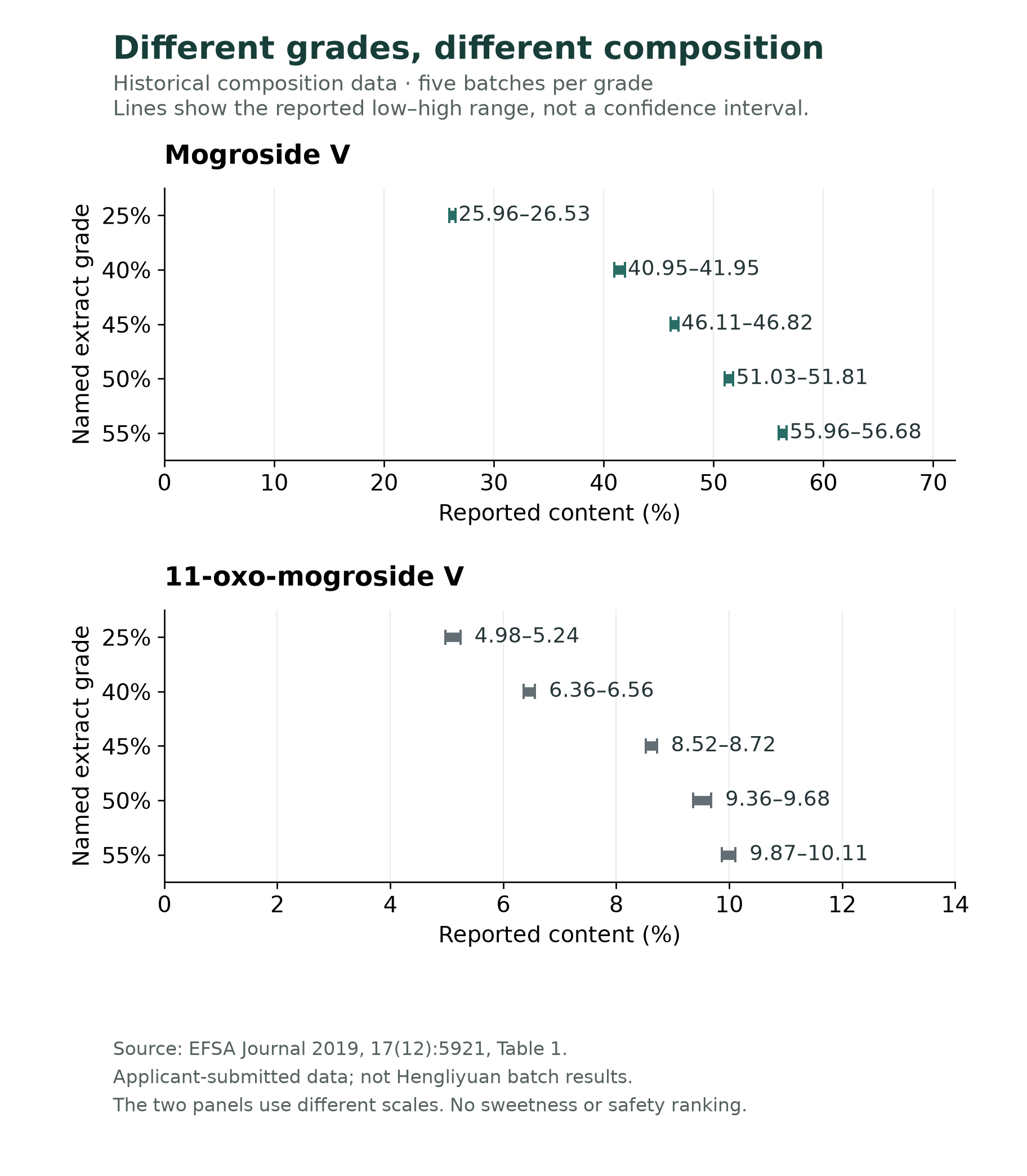
We tested V25% and V50% extracts from six monk fruit extraction factories and chose to buy from Baihongyuan (BHY) and Layn. In our tests, their V25% products came closest to the V25% taste benchmark we use to judge consistency. Their V50% products also tasted very similar in our comparison. Both suppliers operate their own growing bases, use the same seedlings and apply the same fertilizer each year. At our own 600-mu growing base in Guilin, about 40 hectares, we use the same seedlings and apply the same seaweed fertilizer each year. Our monk fruit comes from Guilin, Guangxi. A V25% batch measured 25.23% Mogroside V (lot LHG25-26100803), and a V50% batch measured 50.17% (lot LHV50-26102701). Those results apply to those lots. Check the COA that accompanies your shipment. The chart below shows composition ranges for historical extract grades, including Mogroside V and 11-oxo-mogroside V. Use the chart to understand how composition can differ, then taste the material in your own application.
What to check for EU and US projects
European Union. On 2 October 2024, the Food Safety Authority of Ireland concluded under Article 4 that the monk fruit decoctions described in its consultation were not novel foods. The conclusion covers the described non-selective water extracts, made without selectively enriching mogrosides. Check that your material and process fit the description, then confirm the intended use separately.
Higher-content extracts such as V25% and V50% fall outside that consultation conclusion. EFSA’s 2019 assessment found the submitted toxicology data insufficient to reach a safety conclusion on the extract as a food additive. Check the applicable requirements for your specific material, process, specification and intended use. For a spray-dried powder, ask what was dried, whether the process selectively enriched mogrosides and whether a carrier was added. Check whether the exact material and use require a separate consultation.
United States. FDA has responded to GRAS notices for monk fruit extracts. Match the material’s identity, process, composition and intended use to the relevant notice. Describe its GRAS status using the conditions in that notice.
For other markets, tell us the destination and intended use so we can check the requirements for the proposed material.
How to order
Confirm the grade when you request a sample. See the sample and quote page for sample sizes and order terms. Send us your product, destination market, application, target grade or taste problem, and estimated quantity if known. You can start before you have a finished specification. We will help select a grade and confirm the specification, documents and sample for the material offered. Before ordering, check the analyte, method, reporting basis, specification sheet and COA for the supplied lot.
Common questions
Is Mogroside V the same as total mogrosides?
Mogroside V is one constituent. Total mogrosides is the sum of the mogrosides counted by the specified method. Use the same analyte, method and reporting basis when comparing results.
Can I halve the dose when switching from V25% to V50%?
If the two results are on a comparable basis and you calculate at 25% and 50%, half as much V50% provides the same mass of Mogroside V. Use that as a starting dose and confirm the final dose in your product.
Does a COA prove the extract will taste right?
A COA records the measured composition of the lot. Taste the extract in your actual product at the trial dose to see whether it suits the formula.
Does the EU monk fruit decoction conclusion apply to V25%?
The FSAI conclusion covers the non-selective water extract described in the consultation. V25% cannot rely on that conclusion. Check the requirements for the actual material, process, specification and intended use.
Does “pure” mean 100% Mogroside V?
The word “pure” alone tells you nothing about Mogroside V content. Ask for the analyte, method, reporting basis and measured lot result.
What do I send to start?
Send your product, destination market, application, target grade or taste problem, and quantity if known. You can start before your specification is finalized.