
Sucralose explained
Sucralose Baking Heat Safety: Can You Bake with Sucralose?
Understand sucralose heating questions, the 2026 EFSA findings and BfR advice, and why sweetness retention does not establish baking safety.
Do not treat “heat stable” as a blanket guarantee that sucralose can be used in every baked or fried food. A sweetener retaining sweetness, a finished recipe working physically, and a particular use being safe and permitted are different questions.
For home cooking, the German Federal Institute for Risk Assessment (BfR) advises avoiding the high heating conditions of baking, deep-frying and roasting with sucralose, or adding it after heating. For commercial products, check the specific food category, process and destination-market requirements rather than adopting a general internet baking conversion.
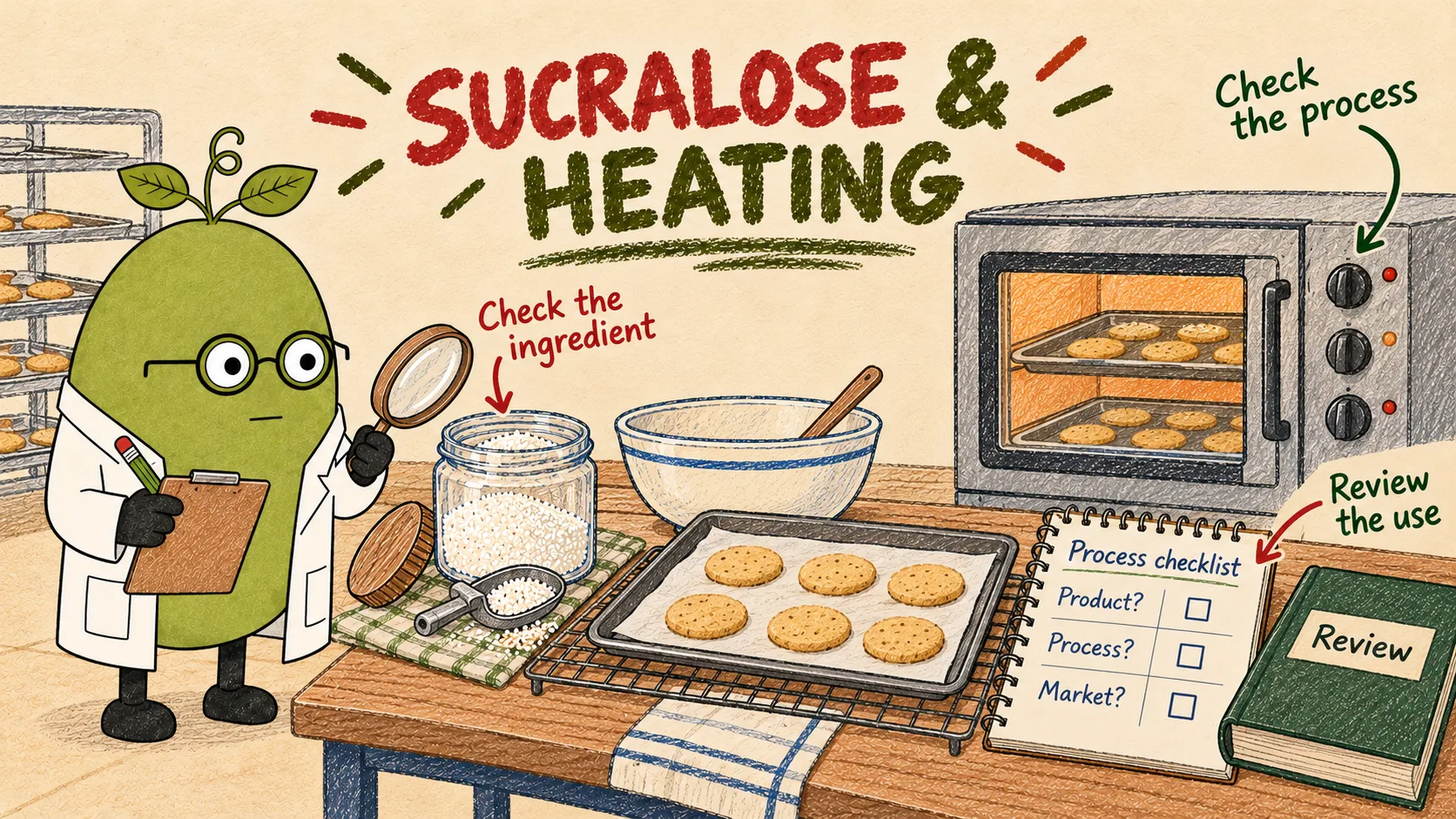
What does the current official heating advice say?
FDA’s US overview describes sucralose as retaining sweetness during baking. Germany’s BfR takes a precautionary position on strong heating, while EFSA’s 2026 review distinguishes current authorised uses from a proposed extension to more fine bakery wares. Read each statement with its purpose and market in view.
- BfR: sucralose heating advice
- FDA: sweetness retention and US use overview
- EFSA: assessment scope and uncertainties
| Source and scope | What it says | How to use the statement |
|---|---|---|
| FDA — United States | Describes sucralose as heat stable, meaning it retains sweetness during baking | Read with US approved conditions of use; sweetness retention is not a test of every recipe |
| EFSA — EU risk assessment, 2026 | No safety concern for current authorised uses; could not confirm the proposed bakery extension | Distinguish the existing-use assessment from a new application and from legal authorisation |
| BfR — German precautionary advice, 2026 | Recommends avoiding strong heating such as baking, deep-frying and roasting, or adding sucralose after heating | This is risk advice, not a statement that every sucralose-containing food is banned |
What did EFSA conclude in 2026?
EFSA reported no safety concern for sucralose under currently authorised uses. It separately evaluated a proposed extension to more fine bakery wares and could not confirm its safety because of uncertainties around prolonged high-temperature conditions. The scope matters: an assessment of existing authorised uses is not approval of every new bakery application. Equally, uncertainty about a proposed extension should not be rewritten as a blanket ban on sucralose. An EFSA risk assessment and the applicable legal authorisation are different documents.
What does the 120°C warning mean?
BfR describes gradual decomposition when sucralose is held above 120°C for a prolonged period, with further change as temperature rises. Its concern includes the possible formation of chlorinated organic compounds during heating. This is why BfR maintains its precautionary advice. The figure is not a universal pass/fail test for a recipe: it does not establish that every process below 120°C is safe. Oven settings alone do not describe the temperature and time experienced throughout a food. Moisture, product size and the complete recipe also matter. A commercial product needs a review of its actual process and intended use. Sweetness, colour and texture measurements cannot establish whether unwanted chemical products are absent.
Replacing sugar changes the baked product as well
Even before the heating question is resolved, sweetness is only one part of sugar replacement. Concentrated sucralose adds a small amount of ingredient mass; it does not replace the weight of removed sugar. A retail baking blend can have a different composition and its own directions. Keep the recipe identity visible. Record which preparation is used and which other ingredients change. A similar level of sweetness does not establish the same dough, finished texture or storage behaviour. These physical observations are useful development checks, but they are not a safety test.
A manufacturing review needs more than a supplier claim
Start with the intended country, food category, exact material, amount used and full process. Ask the responsible regulatory reviewer to confirm the applicable permitted use and label before fixing the commercial formula. Separately obtain the ingredient specification and batch documents. A specification, COA or supplier statement about sweetness cannot substitute for finished-product safety review. Do not extrapolate a result from a beverage to a low-moisture bakery process. If the review is unresolved, keep that application unresolved rather than writing a baking-performance promise into the product brief.
Where should a different application start?
If your actual project is a drink or dry premix, use the guide for that task. It helps define preparation, dosing, distribution and sample observations. Those guides do not certify baking safety and should not be used as a substitute for the heating review above. Hengliyuan’s sucralose ingredient page provides the material enquiry route. Include the destination market and intended use so the discussion does not assume an application that has not been reviewed.
Common questions
Does heat stable mean safe for any baking process?
No. Retaining sweetness and establishing safety under specific heating conditions are separate questions.
Did EFSA ban all sucralose uses in 2026?
No. EFSA found no safety concern for currently authorised uses while identifying uncertainties that prevented confirming a proposed extension to more fine bakery wares.
Can this guide give me a universal safe oven temperature?
No. It does not establish a temperature-and-time safety limit for your recipe. Use current official advice and a process-specific review where needed.
Can a batch COA prove my finished baked food is safe?
No. Ingredient quality documents do not replace the review of the complete recipe, processing conditions and destination-market requirements.
See trial directions for this application